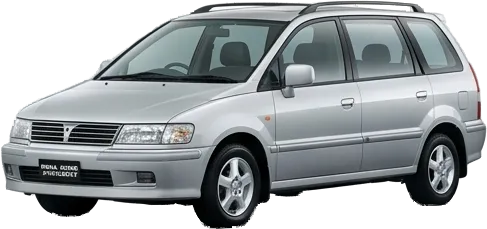
Mitsubishi Space Wagon 2.4 GDI (150 Hp) vs Mitsubishi Space Wagon 2.4 GDi 16V (147 Hp)
Compare up to three variants side by side. Add cars from specs pages or pick a model below.
No cars in comparison yet
Open a model specs page and tap Compare, or browse the catalog to add a car.
Browse cars| Specification | 2.4 GDI (150 Hp) | 2.4 GDi 16V (147 Hp) | — |
|---|---|---|---|
| Overview | |||
| Generation | Gen 3 | Gen 3 | — |
| Year | 1998–2002 | 1998–2003 | — |
| Platform | Mitsubishi Chariot | Mitsubishi Chariot | — |
| Variant | 2.4 GDI (150 Hp) | 2.4 GDi 16V (147 Hp) | — |
| Body type | minivan | minivan | — |
| Engine type | Fuel | Fuel | — |
| Fuel type | Petrol | Petrol | — |
| Seats | 7 | 7 | — |
| Doors | 5 | 5 | — |
| Power & torque | |||
| Power | 150 HP | 147 HP | — |
| Power @ max rpm | 5500 rpm | 5700 rpm | — |
| Torque | 225 Nm (166 lb-ft) | 211 Nm (156 lb-ft) | — |
| Torque @ max rpm | 3500 rpm | 3500 rpm | — |
| Performance | |||
| Top speed | 190 km/h (118 mph) | 190 km/h (118 mph) | — |
| 0–100 km/h | 10.0 s (0-60 mph: ~9.5 s) | 11.4 s (0-60 mph: ~10.8 s) | — |
| 0–62 mph | 10.0 s (0-60 mph: ~9.5 s) | 11.4 s (0-60 mph: ~10.8 s) | — |
| 0–60 mph | 9.5 s | 10.8 s | — |
| Engine | |||
| Engine code | 4G64 | 4G64 | — |
| Displacement | 2351 cc | 2350 cc | — |
| Cylinders | 4 | 4 | — |
| Configuration | inline | inline | — |
| Bore | 87 mm (3.4 in) | 87 mm (3.4 in) | — |
| Stroke | 100 mm (3.9 in) | 100 mm (3.9 in) | — |
| Compression ratio | 11.5 | 10.8 | — |
| Valves per cylinder | 4 | 4 | — |
| Injection system | Direct Injection | Direct Injection | — |
| Aspiration | Naturally Aspirated Engine | Naturally Aspirated Engine | — |
| Valvetrain | ohc | — | — |
| Engine layout | Front Transverse | Front Transverse | — |
| Drivetrain & transmission | |||
| Drive | Front Wheel Drive | Front Wheel Drive | — |
| Powertrain architecture | Internal Combustion Engine | Internal Combustion Engine | — |
| Drivetrain architecture | The Internal Combustion Engine Ice Drives The Front Wheels Of The Vehicle | The Internal Combustion Engine Ice Drives The Front Wheels Of The Vehicle | — |
| Gearbox type | manual | manual | — |
| Gears | 5 | 5 | — |
| Gearbox code | 5mt | 5mt | — |
| Gearbox manufacturer | mitsubishi | mitsubishi | — |
| Dimensions | |||
| Length | 4,600 mm (181.1 in) | 4,600 mm (181.1 in) | — |
| Width | 1,775 mm (69.9 in) | 1,775 mm (69.9 in) | — |
| Height | 1,650 mm (65 in) | 1,690 mm (66.5 in) | — |
| Wheelbase | 2,780 mm (109.4 in) | 2,780 mm (109.4 in) | — |
| Front track | 1,500 mm (59.1 in) | 1,500 mm (59.1 in) | — |
| Rear track | 1,535 mm (60.4 in) | 1,535 mm (60.4 in) | — |
| Boot space | 0 – 240 L (0 – 8.5 cu ft) | 240 – 1930 L (8.5 – 68.2 cu ft) | — |
| Mass | |||
| Kerb weight | 1,510 kg (3,329 lbs) | 1,585 kg (3,494 lbs) | — |
| Max weight | 2,180 kg (4,806 lbs) | 2,180 kg (4,806 lbs) | — |
| Max load | 670 kg (1,477 lbs) | 595 kg (1,312 lbs) | — |
| Consumption & emissions | |||
| Fuel tank | 63.0 L (16.6 US gal) | 63.0 L (16.6 US gal) | — |
| Fuel combined | — | 9.6 L/100 km (24.5 US MPG) | — |
| Fuel urban | — | 12.8 L/100 km (18.4 US MPG) | — |
| Fuel extra urban | — | 7.9 L/100 km (29.8 US MPG) | — |
| Chassis & brakes | |||
| Front suspension | Coil Spring | wishbone | — |
| Rear suspension | Coil Spring | Coil Spring | — |
| Front brakes | disc | Ventilated Discs | — |
| Rear brakes | disc | disc | — |
| Power steering | Hydraulic Steering | Hydraulic Steering | — |
| Tire size | 205/65 R15 | 205/65 R15 | — |
| Assisting systems | Abs Anti Lock Braking System | Abs Anti Lock Braking System | — |
| Steering type | — | Steering Rack And Pinion | — |
| Efficiency ratios | |||
| Weight-to-power | 10.1 kg/Hp, 99.3 Hp/tonne | 10.8 kg/Hp, 92.7 Hp/tonne | — |
| Weight-to-torque | 6.7 kg/Nm, 149 Nm/tonne | 7.5 kg/Nm, 133.1 Nm/tonne | — |
| Other | |||
| Start Of Production | 1998 | 1998 | — |
| End Of Production | 2002 | 2003 | — |
| Maximum Speed Mph | 118 | 118 | — |
| Length In | 181.1 | 181.1 | — |
| Width In | 69.9 | 69.9 | — |
| Height In | 65 | 66.5 | — |
| Wheelbase In | 109.4 | 109.4 | — |
| Front Track In | 59.1 | 59.1 | — |
| Rear Back Track In | 60.4 | 60.4 | — |
| Kerb Weight Lbs | 3329 | 3494 | — |
| Max Weight Lbs | 4806 | 4806 | — |
| Max Load Lbs | 1477 | 1312 | — |
| Torque Lbft | 166 | 156 | — |
| Trunk Boot Space Max Cuft | 8.5 | 68.2 | — |
| Fuel Tank Capacity Gal | 16.6 | 16.6 | — |
| Trunk Boot Space Min Cuft | — | 8.5 | — |
| Fuel Economy Combined Mpg Us | — | 24.5 | — |