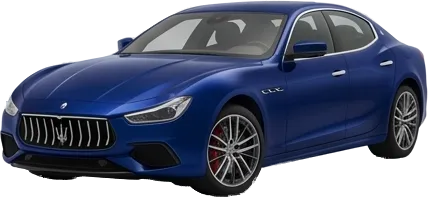
Maserati Ghibli 3.0 V6 (350 Hp) Automatic vs Maserati Ghibli 2.0 GDI (330 Hp) Mild Hybrid Automatic
Compare up to three variants side by side. Add cars from specs pages or pick a model below.
No cars in comparison yet
Open a model specs page and tap Compare, or browse the catalog to add a car.
Browse cars| Specification | 3.0 V6 (350 Hp) Automatic | 2.0 GDI (330 Hp) Mild Hybrid Automatic | — |
|---|---|---|---|
| Overview | |||
| Generation | Gen 3 Facelift 1 | Gen 3 Facelift 1 | — |
| Year | 2017–2018 | 2020–present | — |
| Platform | Maserati M156 | Maserati M156 | — |
| Variant | 3.0 V6 (350 Hp) Automatic [/maserati-ghibli-iii-m157-facelift-2017-3.0-v6-350hp-automatic-27252] | 2.0 GDI (330 Hp) Mild Hybrid Automatic | — |
| Body type | sedan | sedan | — |
| Engine type | Fuel | Mild Hybrid | — |
| Fuel type | Petrol | Petrol | — |
| Seats | 5 | 5 | — |
| Doors | 4 | 4 | — |
| Emission standard | Euro 6 | — | — |
| Power & torque | |||
| Power | 350 HP | 330 HP | — |
| Power @ max rpm | 5500 rpm | 5750 rpm | — |
| Torque | 500 Nm (369 lb-ft) | 450 Nm (332 lb-ft) | — |
| Torque @ min rpm | 1750 rpm | — | — |
| Torque @ max rpm | 4500 rpm | 4000 rpm | — |
| Performance | |||
| Top speed | 267 km/h (166 mph) | 255 km/h (158 mph) | — |
| 0–100 km/h | 5.5 s (0-60 mph: ~5.2 s) | 5.7 s (0-60 mph: ~5.4 s) | — |
| 0–62 mph | 5.5 s (0-60 mph: ~5.2 s) | 5.7 s (0-60 mph: ~5.4 s) | — |
| 0–60 mph | 5.2 s | 5.4 s | — |
| Engine | |||
| Oil capacity | 7.3 L | 5.0 L | — |
| Engine layout | Front Longitudinal | Front Longitudinal | — |
| Engine code | — | GME | — |
| Displacement | — | 1998 cc | — |
| Cylinders | — | 4 | — |
| Configuration | — | inline | — |
| Bore | — | 84 mm (3.3 in) | — |
| Stroke | — | 90 mm (3.5 in) | — |
| Compression ratio | — | 9.5 | — |
| Valves per cylinder | — | 4 | — |
| Injection system | — | Direct Injection | — |
| Aspiration | — | Turbocharger Intercooler | — |
| Coolant | — | 15.9 L | — |
| Engine systems | — | Start Stop System | — |
| Drivetrain & transmission | |||
| Drive | Rear Wheel Drive | Rear Wheel Drive | — |
| Powertrain architecture | Internal Combustion Engine | Mhev Mild Hybrid Electric Vehicle Power Assist Hybrid Battery Assisted Hybrid Vehicles Bahv | — |
| Gearbox type | Torque Converter | Torque Converter | — |
| Gears | 8 | 8 | — |
| Gearbox code | 8hp70 | 8hp50 | — |
| Gearbox manufacturer | zf | zf | — |
| Drivetrain architecture | — | The Internal Combustion Engine Ice And Electric Motor Drive The Rear Wheels Of The Car With The Ability To Work Only In Mixed Mode | — |
| Dimensions | |||
| Length | 4,971 mm (195.7 in) | 4,971 mm (195.7 in) | — |
| Width | 1,945 mm (76.6 in) | 1,945 mm (76.6 in) | — |
| Height | 1,461 mm (57.5 in) | 1,461 mm (57.5 in) | — |
| Wheelbase | 2,998 mm (118 in) | 2,998 mm (118 in) | — |
| Front track | 1,635 mm (64.4 in) | 1,635 mm (64.4 in) | — |
| Rear track | 1,653 mm (65.1 in) | 1,653 mm (65.1 in) | — |
| Boot space | 500 L (17.7 cu ft) | 500 L (17.7 cu ft) | — |
| Turning circle | 11.7 m | — | — |
| Mass | |||
| Kerb weight | 1,810 kg (3,990 lbs) | 1,878 kg (4,140 lbs) | — |
| Consumption & emissions | |||
| Fuel combined | 8.9 L/100 km (26.4 US MPG) | — | — |
| Fuel urban | 12.6 L/100 km (18.7 US MPG) | — | — |
| Fuel extra urban | 6.8 L/100 km (34.6 US MPG) | — | — |
| CO₂ emissions | 207 g/km | — | — |
| Fuel tank | 80.0 L (21.1 US gal) | 80.0 L (21.1 US gal) | — |
| Fuel combined (WLTP) | — | 8.5 L/100 km (27.7 US MPG) | — |
| CO₂ (WLTP) | — | 192 g/km | — |
| Chassis & brakes | |||
| Front suspension | Double Wishbone | Double Wishbone | — |
| Rear suspension | Independent Multi Link Suspension | Independent Multi Link Suspension | — |
| Front brakes | Ventilated Discs | Ventilated discs, 345x28 mm | — |
| Rear brakes | Ventilated Discs | Ventilated discs, 330x22 mm | — |
| Steering type | Steering Rack And Pinion | — | — |
| Power steering | Electric Steering | — | — |
| Tire size | 235/50 R18 | 235/50 R18 | — |
| Wheel rims | 18 | 18 | — |
| Assisting systems | Abs Anti Lock Braking System | Abs Anti Lock Braking System | — |
| Efficiency ratios | |||
| Weight-to-power | 5.2 kg/Hp, 193.4 Hp/tonne | 5.7 kg/Hp, 175.7 Hp/tonne | — |
| Weight-to-torque | 3.6 kg/Nm, 276.2 Nm/tonne | 4.2 kg/Nm, 239.6 Nm/tonne | — |
| Other | |||
| Start Of Production | 2017 | 2020 | — |
| End Of Production | 2018 | — | — |
| Width Including Mirrors | 2128 | — | — |
| Front Overhang | 935 | — | — |
| Rear Overhang | 1038 | — | — |
| Maximum Speed Mph | 166 | 158 | — |
| Length In | 195.7 | 195.7 | — |
| Width In | 76.6 | 76.6 | — |
| Height In | 57.5 | 57.5 | — |
| Wheelbase In | 118 | 118 | — |
| Front Track In | 64.4 | 64.4 | — |
| Rear Back Track In | 65.1 | 65.1 | — |
| Width Including Mirrors In | 83.8 | — | — |
| Kerb Weight Lbs | 3990 | 4140 | — |
| Torque Lbft | 369 | 332 | — |
| Trunk Boot Space Min Cuft | 17.7 | 17.7 | — |
| Fuel Tank Capacity Gal | 21.1 | 21.1 | — |
| Fuel Economy Combined Mpg Us | 26.4 | — | — |
| Fuel Economy Combined Wltp Mpg Us | — | 27.7 | — |