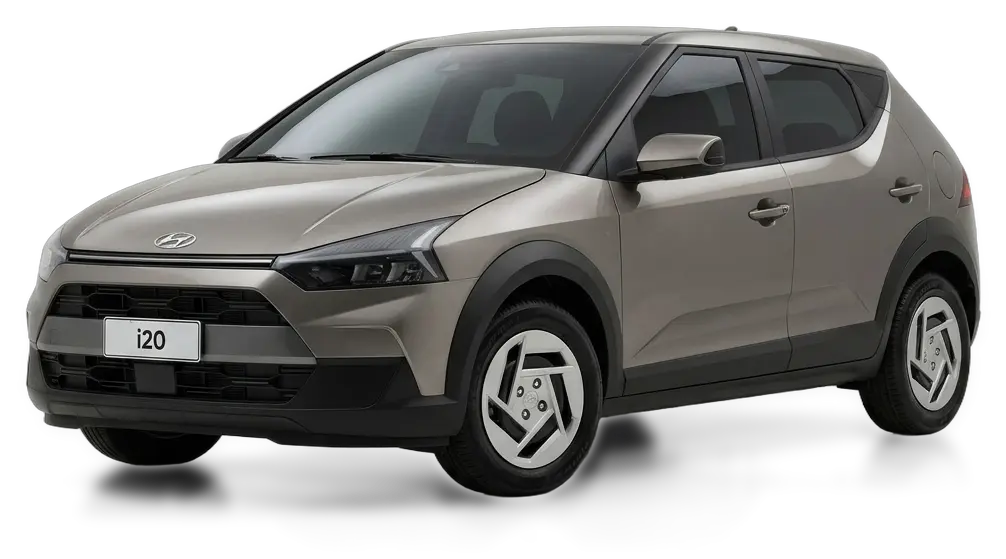
Hyundai i20 1.0 MPI (75/80 Hp) Flex vs Hyundai i20 1.0 T-GDI (115 Hp) Flex Automatic
Compare up to three variants side by side. Add cars from specs pages or pick a model below.
No cars in comparison yet
Open a model specs page and tap Compare, or browse the catalog to add a car.
Browse cars| Specification | 1.0 MPI (75/80 Hp) Flex | 1.0 T-GDI (115 Hp) Flex Automatic | — |
|---|---|---|---|
| Overview | |||
| Generation | Gen 4 | Gen 4 | — |
| Year | 2026–present | 2026–present | — |
| Platform | Hyundai-Kia K2 | Hyundai-Kia K2 | — |
| Variant | 1.0 MPI (75/80 Hp) Flex | 1.0 T-GDI (115 Hp) Flex Automatic | — |
| Body type | Hatchback | Hatchback | — |
| Engine type | Fuel | Fuel | — |
| Fuel type | Petrol | Petrol | — |
| Seats | 5 | 5 | — |
| Doors | 5 | 5 | — |
| Power & torque | |||
| Power | 75 HP | 115 HP | — |
| Power @ max rpm | 6200 rpm | 6000 rpm | — |
| Torque | 94 Nm (69 lb-ft) | 172 Nm (127 lb-ft) | — |
| Torque @ max rpm | 4250 rpm | — | — |
| Performance | |||
| Top speed | 160 km/h (99 mph) | 184 km/h (114 mph) | — |
| 0–100 km/h | 15.5 s (0-60 mph: ~14.7 s) | 11.7 s (0-60 mph: ~11.1 s) | — |
| 0–62 mph | 15.5 s (0-60 mph: ~14.7 s) | 11.7 s (0-60 mph: ~11.1 s) | — |
| 0–60 mph | 14.7 s | 11.1 s | — |
| Engine | |||
| Engine code | F3LA | F3LC | — |
| Displacement | 998 cc | 998 cc | — |
| Cylinders | 3 | 3 | — |
| Configuration | Inline | Inline | — |
| Bore | 71 mm (2.8 in) | 71 mm (2.8 in) | — |
| Stroke | 84 mm (3.3 in) | 84 mm (3.3 in) | — |
| Compression ratio | 11.5 | 10.5 | — |
| Valves per cylinder | 4 | 4 | — |
| Injection system | Multi-port manifold injection | Direct injection | — |
| Aspiration | Naturally aspirated engine | Turbocharger, Intercooler | — |
| Valvetrain | DOHC D-CVVT | DOHC D-CVVT | — |
| Oil capacity | 3.3 L | 3.6 L | — |
| Coolant | 4.6 L | 5.5 L | — |
| Engine layout | Front, Transverse | Front, Transverse | — |
| Engine systems | — | Start & Stop System | — |
| Drivetrain & transmission | |||
| Drive | Front wheel drive | Front wheel drive | — |
| Powertrain architecture | Internal Combustion engine | Internal Combustion engine | — |
| Drivetrain architecture | The Internal combustion engine (ICE) drives the front wheels of the vehicle. | The Internal combustion engine (ICE) drives the front wheels of the vehicle. | — |
| Gearbox type | manual | torque_converter | — |
| Gears | 5 | 6 | — |
| Gearbox code | M5F | a6gf1 | — |
| Gearbox manufacturer | Kia Hyundai | hyundai | — |
| Dimensions | |||
| Length | 4,130 mm (162.6 in) | 4,130 mm (162.6 in) | — |
| Width | 1,780 mm (70.1 in) | 1,780 mm (70.1 in) | — |
| Height | 1,495 mm (58.9 in) | 1,495 mm (58.9 in) | — |
| Wheelbase | 2,580 mm (101.6 in) | 2,580 mm (101.6 in) | — |
| Boot space | 346 – 1152 L (12.2 – 40.7 cu ft) | 346 – 1152 L (12.2 – 40.7 cu ft) | — |
| Ground clearance | 160 mm (6.3 in) | 160 mm (6.3 in) | — |
| Mass | |||
| Kerb weight | 1,075 kg (2,370 lbs) | 1,175 kg (2,590 lbs) | — |
| Max weight | 1,535 kg (3,384 lbs) | 1,640 kg (3,616 lbs) | — |
| Max load | 445 kg (981 lbs) | 435 kg (959 lbs) | — |
| Consumption & emissions | |||
| Fuel urban | 7.3 L/100 km (32.2 US MPG) | 7.9 L/100 km (29.8 US MPG) | — |
| Fuel extra urban | 6.8 L/100 km (34.6 US MPG) | 7.0 L/100 km (33.6 US MPG) | — |
| Fuel tank | 45.0 L (11.9 US gal) | 50.0 L (13.2 US gal) | — |
| Chassis & brakes | |||
| Front suspension | Independent, McPherson type with coil spring and anti-roll bar | Independent, McPherson type with coil spring and anti-roll bar | — |
| Rear suspension | Coil spring, Torsion bar | Coil spring, Torsion bar | — |
| Front brakes | Ventilated discs | Ventilated discs | — |
| Rear brakes | Drum | Disc | — |
| Steering type | Steering rack and pinion | Steering rack and pinion | — |
| Power steering | Electric Steering | Electric Steering | — |
| Tire size | 185/65 R15; 195/55 R16 | 195/55 R16; 205/50 R17 | — |
| Wheel rims | 5.5J x 15; 6J x 16 | 6J x 16; 6.5J x 17 | — |
| Assisting systems | ABS (Anti-lock braking system) | ABS (Anti-lock braking system) | — |
| Efficiency ratios | |||
| Weight-to-power | 14.3 | 10.2 | — |
| Weight-to-torque | 11.4 | 6.8 | — |
| Other | |||
| Start Of Production | 2026 | 2026 | — |
| Maximum Speed Mph | 99 | 114 | — |
| Length In | 162.6 | 162.6 | — |
| Width In | 70.1 | 70.1 | — |
| Height In | 58.9 | 58.9 | — |
| Wheelbase In | 101.6 | 101.6 | — |
| Ride Height Ground Clearance In | 6.3 | 6.3 | — |
| Kerb Weight Lbs | 2370 | 2590 | — |
| Max Weight Lbs | 3384 | 3616 | — |
| Max Load Lbs | 981 | 959 | — |
| Torque Lbft | 69 | 127 | — |
| Trunk Boot Space Min Cuft | 12.2 | 12.2 | — |
| Trunk Boot Space Max Cuft | 40.7 | 40.7 | — |
| Fuel Tank Capacity Gal | 11.9 | 13.2 | — |