
The European Parliament has voted to relax the planned 2035 ban on combustion engines. A recent parliamentary committee approved a proposal that allows up to 30% of new cars sold after 2035 to still have internal combustion engines (ICE), marking a change from the original idea of a full phase-out.
New Emission Targets and Exceptions
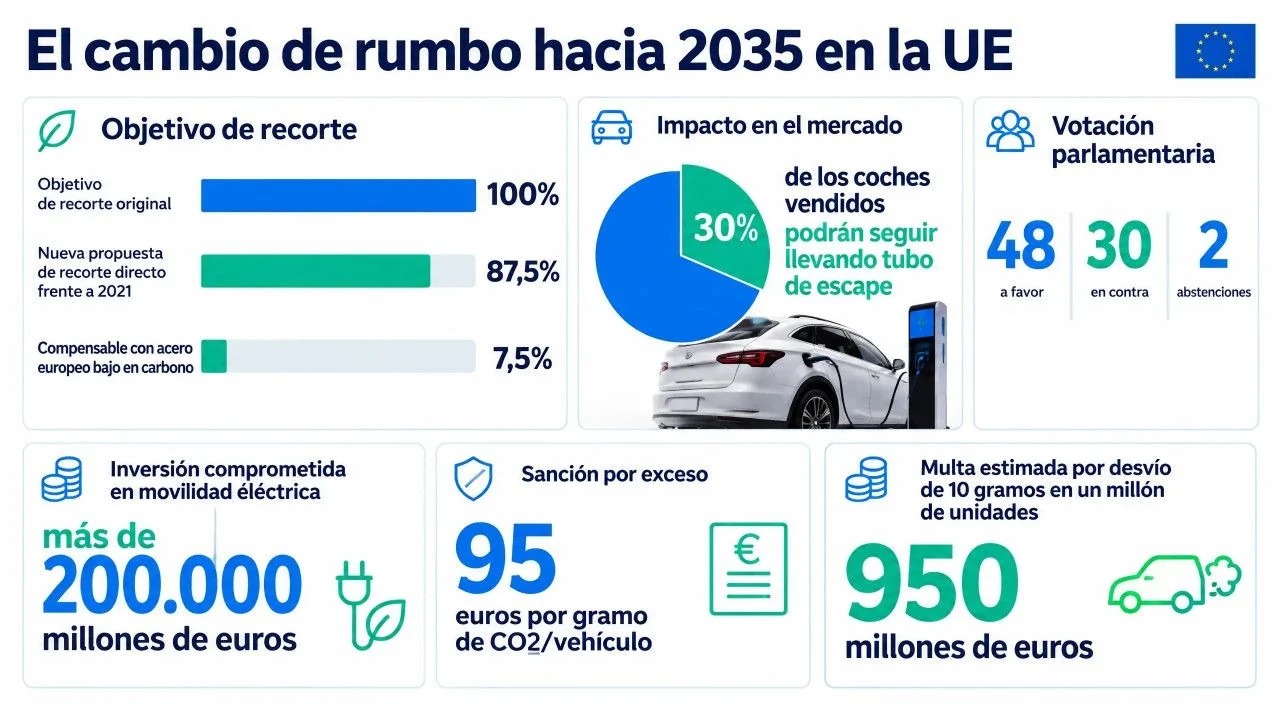
On November 4, the European Parliament’s committee passed a proposal by Massimiliano Salini with 48 votes in favor, 30 against, and 2 abstentions. The measure will go to a full parliamentary vote in December before entering negotiations with the EU Commission and Council.
The new emission reduction target for 2035 lowers the cut from 100% to 87.5% compared to 2021 levels. An additional 7.5% can be offset using European-produced low-carbon steel. This means around one-third of new vehicles after 2035 could still have tailpipes and run on combustion engines.
Furthermore, vehicles powered exclusively by sustainable fuels—such as synthetic fuels or e-fuels—would count as zero emissions. The proposal also introduces fleet multipliers favoring models manufactured within the EU.
Challenges of Sustainable Fuels and Market Uncertainty
While recognizing synthetic fuels as zero emissions appears positive on paper, the reality for users is quite different. E-fuels remain expensive and difficult to source, acting more as a temporary fix than a long-term solution. Their emissions of harmful pollutants are nearly the same as those from conventional fuels, limiting their benefit for urban air quality.
Experts warn that the bigger problem lies in the shifting regulatory landscape itself. Frequent changes create uncertainty for manufacturers and buyers alike. This instability risks slowing down investments in electric vehicle (EV) technologies, where over €200 billion has already been committed in Europe’s EV ecosystem, according to Transport & Environment.
Industry Pressure and Risks for European Brands
The EU’s easing of emission rules comes amid pressure from traditional carmakers. These manufacturers face hefty fines of €95 per gram of excess CO2 per vehicle sold. For large companies, such penalties could reach hundreds of millions of euros, severely affecting budgets for new model development.
However, this concession may backfire. If European brands delay delivering affordable, technologically advanced EVs, consumers will increasingly turn to foreign, especially Chinese, manufacturers. Chinese automakers are advancing quickly, with competitive technology and growing manufacturing presence within Europe, sidestepping tariffs.
Spain, with its strong industrial base and attractive energy costs, could become a key location for Asian investment in EV production plants and components, potentially benefiting from these shifts.
A Complicated Transition with No Clear Winner Yet
Negotiations continue between France and Germany in the EU Council, pushing for stricter targets—such as a 90% direct emission cut without exceptions for low-carbon steel or sustainable fuels. Meanwhile, the European Automobile Manufacturers Association (ACEA) demands even more flexibility.
This ongoing debate leaves consumers confused about the future of vehicle emissions standards and may delay their purchase decisions.
Ultimately, combustion engines are expected to disappear as electric vehicles provide better efficiency and lower running costs. Delaying this transition risks the European automotive industry losing ground permanently to competitors committed to electrification.
Source: Original article published in November 2023.
Source: motor.es

Software Developer & Tech Journalist. Creator of Autodatalog.com. Experienced in Python, PHP, PostgreSQL, and Android system modifications. Whether I'm writing Python automation scripts, or exploring the technical specs of Fiat/Alfa Romeo engines, I love reverse-engineering how things work. Based in Istanbul, Turkey.