HYUNDAI
Hyundai Kona SX2 (2023–2025) Specs
Specifications, engines, dimensions and technical data.
Gen 2
2023 - 2025
SX2
SUV
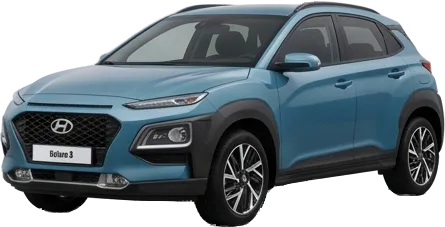
W
L
H
WB
GC
Boot
Engine
—
Power
—
Fuel
—
Gears
—
Platform
—
Body Style
Chassis
Engines
Quick Specs
Fuel
Fuel
Combined
Combined
Engine Lineup
| Trans | Engine | Gears | HP | Fuel | CO₂ |
|---|---|---|---|---|---|
| MT | 1.0T DCT | 6 | 120 HP | Petrol | — |
| DCT | 1.6 GDI Full Hybrid DCT | 6 | 141 HP | Petrol | — |
| MT | 1.6 T-GDI | 6 | 150 HP | Petrol | — |
| DCT | 1.6 T-GDI DCT | 7 | 180 HP | Petrol | — |
| MT | 1.6T DCT | 6 | 198 HP | Petrol | — |
| MT | 2.0 MPI IVT | 1 | 147 HP | Petrol | — |
| AT | 48.4 kWh Electric | 1 | 156 HP | Electric | — |
| AT | 49 kWh Electric | 1 | 135 HP | Electric | — |
| AT | 65 kWh Electric | 1 | 204 HP | Electric | — |
| AT | 65.4 kWh Electric | 1 | 218 HP | Electric | — |
Note: Performance figures may vary based on market and conditions.
Hyundai Kona SX2 overview
The Hyundai Kona (SX2) is the 2nd generation of the Kona, built from 2023 to 2025. It is offered as a SUV with 9 engines (electric, petrol), from 93 HP to 150 HP. The 1.0 T-GDI (100 Hp) accelerates from 0 to 100 km/h in 13.3 s, reaches a top speed of 169 km/h and is 4350 mm long.
How much horsepower does the Hyundai Kona have?
The Hyundai Kona (SX2) has 93 HP to 150 HP, depending on the engine: 218 Electric, 204 Electric, 135 Electric, 156 Electric, 1.6 Kappa (93 HP), 1.0 Kappa (100 HP), 1.6 Smartstream (138 HP), 2.0 Smartstream (147 HP), 1.6 Smartstream (150 HP).
What engines are available for the Hyundai Kona?
The Hyundai Kona is available with 9 engines: 218 Electric, 204 Electric, 135 Electric, 156 Electric, 1.6 Kappa (93 HP, petrol), 1.0 Kappa (100 HP, petrol), 1.6 Smartstream (138 HP, petrol), 2.0 Smartstream (147 HP, petrol), 1.6 Smartstream (150 HP, petrol).
What are the dimensions of the Hyundai Kona?
The Hyundai Kona is 4350 mm long, 1825 mm wide, 1585 mm tall, with a 2660 mm wheelbase.
How fast is the Hyundai Kona?
The Hyundai Kona 1.0 T-GDI (100 Hp) goes from 0 to 100 km/h in 13.3 s and has a top speed of 169 km/h.
Advanced Specs
Overview
| Generation | Hyundai Kona II |
|---|---|
| Year | 2024–2025 |
| Platform | Hyundai-Kia K2 |
| Variant | 1.0 T-GDI (100 Hp) |
| Body type | suv |
| Engine type | Fuel |
| Fuel type | Petrol |
| Seats | 5 |
| Doors | 5 |
| Emission standard | Euro 6e |
Power & torque
| Power | 100 HP |
|---|---|
| Power @ max rpm | 6000 rpm |
| Torque | 200 Nm |
| Torque @ min rpm | 2000 rpm |
| Torque @ max rpm | 2500 rpm |
Performance
| Top speed | 169 km/h |
|---|---|
| 0–100 km/h | 13.3 s |
| 0–62 mph | 13.3 s |
Engine
| Engine code | G3LC |
|---|---|
| Displacement | 998 cc |
| Cylinders | 3 |
| Configuration | inline |
| Injection system | Direct Injection |
| Aspiration | Turbocharger Intercooler |
| Oil capacity | 3.6 L |
| Coolant | 4.5 L |
| Engine layout | Front Transverse |
| Engine systems | Start Stop Systemparticulate Filter |
Drivetrain & transmission
| Drive | Front Wheel Drive |
|---|---|
| Powertrain architecture | Internal Combustion Engine |
| Drivetrain architecture | The Internal Combustion Engine Ice Drives The Front Wheels Of The Vehicle |
| Gearbox type | manual |
| Gears | 6 |
| Gearbox code | manual |
| Gearbox manufacturer | hyundai |
Dimensions
| Length | 4350 mm |
|---|---|
| Width | 1825 mm |
| Height | 1585 mm |
| Wheelbase | 2660 mm |
| Front track | 1602 mm |
| Rear track | 1611 mm |
| Boot space | 466 – 1300 L |
| Ground clearance | 160 mm |
Mass
| Kerb weight | 1295 kg |
|---|---|
| Kerb weight (min) | 1295 kg |
| Kerb weight (max) | 1435 kg |
| Max weight | 1860 kg |
| Max load | 425 kg |
Consumption & emissions
| Fuel combined (WLTP) | 5.7 L/100km |
|---|---|
| CO₂ (WLTP) | 129 g/km |
| Fuel tank | 47.0 L |
Chassis & brakes
| Front suspension | Independent Type Mcpherson |
|---|---|
| Rear suspension | torsion |
| Front brakes | Ventilated Discs |
| Rear brakes | disc |
| Steering type | Steering Rack And Pinion |
| Power steering | Electric Steering |
| Tire size | 205/65 R16 |
| Wheel rims | 6.5J x 16 |
| Assisting systems | Abs Anti Lock Braking System |
Efficiency ratios
| Weight-to-power | 13 kg/Hp, 77.2 Hp/tonne |
|---|---|
| Weight-to-torque | 6.5 kg/Nm, 154.4 Nm/tonne |
| Max roof load | 100 kg |
Other
| Start Of Production | 2024 |
|---|---|
| End Of Production | 2025 |
Performance
Engine speed (1k/rpm)
! Figures from catalog data; real-world values may differ.
0 cars selected